Foundations and First Steps (1792-1860)
The Original Institutional Architecture
The creation of the American dollar forms part of an ambitious political project: giving the young republic full monetary sovereignty. Signed by George Washington, the Coinage Act of 2 April 1792 does more than establish a new currency; it creates a true institutional revolution by founding the United States Mint.
David Rittenhouse, a renowned astronomer and inventor, becomes the first director of this revolutionary institution. Under his leadership, the first silver dollars are struck in 1794, marking the USD's tangible birth. Known as "Flowing Hair dollars", these first coins represent a considerable technical challenge for their time.
Early American coin production reveals the young nation's ambitions and limitations. Between 1794 and 1795, only 1 758 silver dollars are struck, illustrating the technical and financial constraints of the period. Each coin requires painstaking craftsmanship, and variations in weight and purity reflect the challenges of emerging industrial standardisation.
1795 : Introduction of "Draped Bust dollars"
1804 : Silver dollar production suspended
1840 : Limited reintroduction of silver dollars
1849 : First gold dollars following the California gold rush
1857 : Foreign coins cease to be legal tender
The Challenges of a Decentralised Banking System (1792-1860)
The absence of a central bank between 1836 and 1913 creates an extraordinarily complex monetary system. More than 1 600 state banks issue their own banknotes, creating a veritable monetary labyrinth in which thousands of different denominations circulate simultaneously.
This period, known as the "Free Banking Era", sees remarkable innovations alongside massive fraud. "Wildcat banks", established in remote locations to discourage redemption requests, issue notes without sufficient backing. Meanwhile, respectable institutions such as the Bank of North America develop quality standards that foreshadow the modern banking system.
Recurring financial crises—in 1819, 1837 and 1857—reveal the structural weaknesses of this decentralised system. Each crisis sees hundreds of banks fail, their notes instantly becoming worthless and ruining their holders. These painful experiences gradually raise public awareness of the need for profound monetary reform.
The Civil War and the Monetary Revolution (1861-1879)
The Emergence of Greenbacks and Fiat Money
The Civil War radically transforms the nature of the American dollar. Faced with unprecedented financing needs—3.4 billion dollars over four years—the federal government revolutionises the American monetary system through the Legal Tender Act of 25 February 1862.
This law authorises the issue of "United States Notes", quickly nicknamed "greenbacks" because of their distinctive green printing. For the first time in American history, the federal government issues large quantities of paper money that cannot be converted into precious metals, creating what is effectively the first modern fiat currency.
The innovation goes beyond monetary technique alone. Treasury Secretary Salmon P. Chase develops a genuine strategy for communication through money. Banknotes feature patriotic mottos ("In God We Trust" appears for the first time) and allegories of liberty and justice, turning currency into an instrument of propaganda and national cohesion.
The economic consequences are considerable. Issuing 450 million dollars in greenbacks generates substantial inflation—prices double between 1861 and 1865—but enables the war effort to be financed without economic collapse. This experience demonstrates the possibilities and risks of modern money creation, leaving a lasting influence on American economic thought.
The National Banking System and Monetary Unification
The National Banking Act of 1863, supplemented in 1864, represents the Civil War's second monetary revolution. This legislation creates a unified national banking system, ending the monetary chaos of the preceding era.
Federally chartered national banks issue "National Bank Notes" backed by federal bonds. This ingenious system combines money creation with financing public debt while guaranteeing banknote uniformity and security. Hugh McCulloch, the first Comptroller of the Currency, oversees this major transformation.
Technical innovation accompanies institutional reform. The introduction of photography into banknote printing, special inks and security papers revolutionises the fight against counterfeiting. Created in 1865, the Secret Service initially specialises in this mission before extending its responsibilities to presidential protection.
The Golden Age and Its Turbulence (1879-1933)
The Return to the Gold Standard and Restored Stability
The "resumption" of 1879—the return to dollar-gold convertibility—marks the United States' entry into the international monetary golden age. Meticulously prepared by Treasury Secretary John Sherman, this decision succeeds through patient accumulation of gold reserves and gradual contraction of the money supply.
Restored monetary stability accompanies America's exceptional economic expansion. Between 1879 and 1914, American GDP quadruples, the United States becomes the world's leading industrial power and the dollar gradually acquires international credibility. This period sees the first signs of future monetary hegemony.
The gold standard also transforms the nature of economic crises. Chronic deflation—prices fall by an average of 1% per year between 1879 and 1896—benefits creditors and penalises debtors, generating considerable social tensions. The populist movement, culminating in William Jennings Bryan's candidacy in 1896, challenges the foundations of orthodox monetary policy.
Large Denominations and Currency Circulation among the Elite
American economic expansion is accompanied by remarkable innovations in currency denominations. In 1918, the US Treasury issues the first 500, 1 000, 5 000 and 10 000 dollar notes, intended for large commercial transactions in a rapidly growing economy.
The 5 000 dollar note, bearing James Madison's portrait, becomes legendary in American literature. In "The Maltese Falcon" (1930), Dashiell Hammett indeed mentions a 5 000 dollar "Madison", demonstrating the denomination's familiarity in wealthy circles of the time. Known as "high denominations", these notes circulate mainly between banks, large companies and wealthy individuals.
This policy reaches its peak in 1934 with the issue of the 100 000 dollar note, bearing Woodrow Wilson's portrait. Unlike other denominations, these "Gold Certificates" never circulate publicly: they serve exclusively for transactions between Federal Reserve Banks, within an interbank clearing system sophisticated for its time.
Portrait: William McKinley
Period: 1918-1969
Use: Large commercial transactions
Portrait: Grover Cleveland
Period: 1918-1969
Use: Bank transfers, investments
Portrait: James Madison
Period: 1918-1969
Use: Transactions between institutions
Portrait: Salmon P. Chase
Period: 1918-1969
Use: Major financial operations
Portrait: Woodrow Wilson
Period: 1934-1969
Use: Federal Reserve transactions only
The Great Depression and Monetary Reconstruction (1929-1945)
The Crash of 1929 and Its Monetary Consequences
The October 1929 crash triggers the most serious monetary crisis in American history. Within three years, one-third of American banks fail, the money supply contracts by 30% and deflation reaches -10% annually. This deflationary spiral reveals the gold standard's deep contradictions during a crisis.
Paralysed by its orthodox doctrine, the Federal Reserve unintentionally worsens the crisis. Following gold-standard rules, it maintains high interest rates to protect gold reserves, further choking an already suffocating economy. Analysed retrospectively by Milton Friedman and Anna Schwartz, this policy vividly illustrates the limits of automatic monetary systems.
The banking panic of March 1933 marks the crisis's peak. Inaugurated on 4 March, Franklin D. Roosevelt immediately declares a national "bank holiday", closing every bank in the country for a week. Unthinkable only a few months earlier, this dramatic measure reveals the scale of the American financial system's collapse.
Roosevelt's Revolution and the Abandonment of the Gold Standard
The Roosevelt administration carries out an unprecedented monetary revolution. Executive Order 6102 of 5 April 1933 prohibits private ownership of gold, requiring Americans to exchange coins and bullion for paper dollars at the official rate of 20.67 dollars an ounce. Unique in American history, this confiscation transforms gold from a monetary instrument into an industrial metal.
Dollar devaluation follows in January 1934. The Gold Reserve Act sets the new gold price at 35 dollars an ounce, effectively devaluing the dollar by 41%. This bold decision revives the economy through controlled inflation and improves the competitiveness of American exports.
These reforms profoundly transform the dollar's nature. No longer convertible for individuals but retaining international convertibility, the USD acquires a hybrid character that foreshadows its future role as a global reserve currency. Institutional innovations—the Federal Deposit Insurance Corporation and Securities and Exchange Commission—simultaneously strengthen confidence in the American financial system.
The gradual withdrawal of large denominations begins during this period. Although officially retained, denominations above 100 dollars see their circulation decline drastically. New banking regulations and the rise of electronic transfers reduce the need for large amounts of cash, initiating the disappearance of these exceptional banknotes.
Global Hegemony: Bretton Woods and Beyond (1944-1971)
Bretton Woods: The Dollar's International Ascendancy
The Bretton Woods Conference (1-22 July 1944) definitively establishes American monetary hegemony. Facing a devastated Europe and a defeated Japan, the United States imposes an international monetary system centred on the dollar, the only currency convertible into gold at a fixed rate of 35 dollars an ounce.
Designed chiefly by Harry Dexter White for the Americans and John Maynard Keynes for the British, this architecture establishes the dollar as the "pivot" of the international monetary system. Other currencies are defined in relation to the dollar, effectively creating American monetary hegemony without historical precedent.
The geopolitical implications are considerable. Control of the international monetary system gives the United States an "exorbitant privilege"—a phrase coined by French minister Valéry Giscard d'Estaing—allowing it to finance deficits simply by creating money. This unique situation strengthens American power and has a lasting influence on the structure of international economic relations.
1945 : Agreements ratified by 44 countries
1958 : European currencies return to convertibility
1968 : Creation of the two-tier gold market
1971 : "Nixon Shock"—suspension of gold convertibility
1973 : Final collapse of the Bretton Woods system
The System's Peak and Contradictions (1945-1971)
America's post-war boom corresponds to the peak of the Bretton Woods system. Exceptional economic growth, expanding international trade and stable exchange rates create an ideal economic environment. The dollar truly becomes the world's currency, used in 80% of international transactions by 1960.
This period also sees the spectacular rise of the Eurodollar market. From the 1950s, European banks collect and lend dollars outside American jurisdiction, creating a parallel market beyond the control of US monetary authorities. This development foreshadows contemporary financial globalisation.
However, the system's contradictions gradually accumulate. The Triffin dilemma, identified by Belgian economist Robert Triffin, reveals the system's structural impossibility: to supply the world with liquidity, the United States must maintain chronic deficits, but these deficits erode confidence in dollar convertibility.
Tensions intensify in the 1960s. The Vietnam War, "Great Society" social programmes and growing European and Japanese competition weaken America's external position. US gold reserves, which represented 70% of the world stock in 1945, fall to 22% in 1970.
The Post-Bretton Woods Era: Towards Financial Globalisation (1971-2008)
The Nixon Shock and the Birth of the Floating Dollar
On 15 August 1971, Richard Nixon announces the "temporary" suspension of dollar-gold convertibility, unilaterally ending the Bretton Woods system. Prepared in secret by Paul Volcker and John Connally, this decision constitutes one of modern monetary history's most significant breaks.
Paradoxically, this "closing of the gold window" frees the dollar from its metallic constraints. Now a purely fiat currency, the USD can adapt to the needs of the global economy without the gold standard's rigidities. Contrary to pessimistic predictions, this greater flexibility strengthens the dollar's international position.
The Smithsonian Agreement (December 1971) briefly attempts to maintain fixed exchange rates without reference to gold, but quickly fails. In March 1973, the major currencies definitively move to floating exchange rates, opening the contemporary era of international monetary volatility.
The Petrodollar Innovation and Monetary Recycling
The oil shocks of 1973 and 1979 create a new mechanism of monetary dominance: the petrodollar system. Agreements with Saudi Arabia and other oil producers establish the dollar as the sole currency for oil invoicing, creating massive structural demand for the American currency.
This system generates a self-sustaining cycle: oil-importing countries must acquire dollars for energy purchases, while exporting countries accumulate dollar surpluses that they recycle into the American economy through Wall Street's financial markets. This architecture considerably strengthens American monetary hegemony.
Paul Volcker, Fed Chairman from 1979 to 1987, simultaneously pursues a revolutionary monetary policy to combat inflation. By raising US interest rates above 20%, he triggers a severe recession but restores the dollar's anti-inflation credibility. This drastic policy lays the foundations of the "Great Moderation" of subsequent decades.
Financial Globalisation and Dollar Expansion
The 1980s-2000s see financial globalisation explode, with the dollar at the centre of every flow. Capital market liberalisation, financial innovation and the technological revolution transform the USD into the global economy's true nervous system.
The discontinuation of large denominations becomes official in 1969: 500, 1 000, 5 000, 10 000 and 100 000 dollar notes cease to be printed. Motivated by the fight against organised crime and tax evasion, this decision also symbolises the shift towards an increasingly cashless economy.
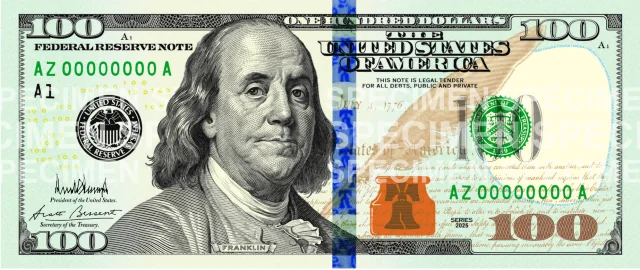
Paradoxically, this period sees global demand for 100 dollar notes surge. Around 70% of these notes circulate abroad, serving as a store of value in unstable economies or as a parallel currency in countries in crisis. The "Benjamin Franklin" thus becomes the most internationalised banknote in history.
| Decade | Dollars in Circulation (Billions) | International Share | Major Innovation |
|---|---|---|---|
| 1970 | 54 | 35% | Eurodollars |
| 1980 | 128 | 45% | Petrodollars |
| 1990 | 267 | 55% | Financial globalisation |
| 2000 | 571 | 65% | Internet and electronic trading |
The Dollar in the 21st Century: Challenges and Adaptation (2001-2024)
The 2008 Crisis and the Demonstration of Strength
The financial crisis of 2008 is the ultimate test of American monetary hegemony. Paradoxically, this crisis originating in the United States strengthens the dollar's international position. During the panic of September-October 2008, investors worldwide seek refuge in American assets, illustrating the dollar's status as the "ultimate safe haven".
The Federal Reserve's response reveals the extent of its global influence. Swap programmes with foreign central banks, massive liquidity injections and the innovation of "quantitative easing" demonstrate the Fed's unique ability to act as a global lender of last resort.
Ben Bernanke, Fed Chairman during the crisis, orchestrates a revolutionary monetary policy. Interest rates fall to zero, and the Fed purchases more than 3 000 billion dollars in securities, increasing its balance sheet by 900%. Unthinkable only a few years earlier, this ultra-expansionary policy saves the global financial system.
The Emergence of Structural Challenges
The post-2008 period brings new challenges to dollar hegemony. China's emergence as the world's second-largest economy is accompanied by a deliberate strategy to internationalise the yuan. Bilateral swap agreements, the "Belt and Road" initiative and the creation of alternative financial institutions (the Asian Infrastructure Investment Bank) explicitly aim to reduce dependence on the dollar.
At the same time, the digital revolution transforms the very nature of money. The emergence of cryptocurrencies, the rise of dollar-pegged stablecoins and central bank digital currency (CBDC) projects redefine the boundaries of monetary sovereignty. Although abandoned, Facebook's Libra/Diem project illustrates the challenges posed by private technology companies.
The COVID-19 pandemic further accelerates these transformations. Massive monetary injections—more than 5 000 billion dollars in two years—raise concerns about inflation and the sustainability of ultra-accommodative monetary policy. Paradoxically, this unprecedented money creation temporarily strengthens international demand for dollars.
Technological Innovation and the Dollar's Transformation
Jerome Powell, Fed Chairman since 2018, faces unprecedented challenges. Monetary policy must now accommodate rapid technological change, the emergence of cryptocurrencies and growing geopolitical pressures. In 2021, the Fed launches its own digital dollar (CBDC) project, implicitly recognising that the monetary future will be digital.
This technological evolution also transforms the physical circulation of dollars. The 100 dollar note now accounts for 80% of the total value of cash in circulation, a concentration never before seen in monetary history. This "dollarisation" through large banknotes reflects their massive international use as a store of value.
Artificial intelligence simultaneously revolutionises monetary policy. Fed algorithms now analyse millions of economic data points in real time, enabling unparalleled responsiveness. This "Fed 4.0" has analytical and intervention tools that would have been impossible during previous crises.
Contemporary Dollar Geopolitics
The Dollar as a Geopolitical Weapon
The Trump administration (2017-2021), followed by the Biden administration (2021-), makes extensive use of economic sanctions as a foreign-policy instrument. American control of the SWIFT system, the requirement for international banks to comply with US regulations and the extraterritorial reach of American law transform the dollar into a formidable geopolitical weapon.
Sanctions against Russia (2014, 2022), Iran (2018) and various Chinese entities illustrate this "weaponisation" of the dollar. Exclusion from SWIFT, the freezing of dollar assets and denial of access to American financial markets constitute sanctions of unprecedented effectiveness in the history of international relations.
However, this use of the dollar prompts efforts to circumvent it. Russia and China develop alternative payment systems (Russia's SPFS and China's CIPS), Iran experiments with international barter and the European Union creates INSTEX to trade with Iran. Although limited, these initiatives signal a desire to reduce dependence on the dollar system.
Emerging Monetary Competition
Launched in 1999, the euro represents the first credible alternative to the dollar since Bretton Woods. Although its share of global reserves plateaus around 20%, the euro demonstrates the feasibility of a modern supranational currency. The European Central Bank develops its own international monetary policy instruments, creating an alternative centre of attraction.
The Chinese yuan advances slowly but steadily. Its inclusion in the IMF's Special Drawing Rights in 2016 constitutes official recognition of its growing international status. "Panda bonds", yuan-denominated oil contracts and the expansion of yuan use in China's bilateral trade signal a gradual but determined rise.
Cryptocurrencies present a new kind of challenge. Explicitly designed as an alternative to the traditional monetary system, Bitcoin attracts institutional and individual investors seeking to escape central bank influence. Stablecoins, paradoxically often pegged to the dollar, create a "private dollar" partly beyond the control of monetary authorities.
Institutional Structure and Contemporary Mechanisms
The Architecture of the Modern Federal Reserve
The contemporary Federal Reserve is the world's most powerful financial institution. Its twelve regional banks, overseen by a seven-member Board of Governors appointed for fourteen years, manage an extraordinarily complex system. The Fed supervises more than 5 000 banking institutions, controls monetary policy for the world's largest economy and directly influences international financial conditions.
The Federal Open Market Committee (FOMC), which meets eight times a year, makes the world's most closely watched monetary policy decisions. Every Fed statement triggers movements across international financial markets, illustrating the dollar's central influence in the global economy.
The innovation of "forward guidance" and strategic communication transforms the conduct of monetary policy. Since Alan Greenspan, Fed chairs have used speeches as monetary policy instruments, with their every word analysed by thousands of economists and traders. This "Fed speak" becomes a subtle art of economic communication.
The Mechanisms of Money Creation and Circulation
Contemporary dollar creation relies on mechanisms of remarkable technical sophistication. The Bureau of Engraving and Printing produces 7 to 9 billion banknotes annually, using some of the world's most advanced security technologies. Magnetic inks, 3D holograms, microprinting and security strips make the modern dollar one of the hardest currencies to counterfeit.
Physical distribution takes place through a network of 28 automated processing centres, capable of handling 100 000 banknotes per hour. Unique in the world, this logistical infrastructure ensures that physical dollars are available in the planet's most remote corners. Approximately 1.2 trillion dollars circulate physically, two-thirds of them abroad.
However, the gradual shift away from physical money transforms the nature of monetary circulation. Fedwire electronic transfers process 4 000 billion dollars daily, 200 times the value of cash in circulation. This electronic economy makes the dollar omnipresent yet invisible, travelling at the speed of light through the planet's fibre-optic networks.
The Dollar's Economic and Social Impact
The Effects of Monetary Hegemony on the American Economy
The dollar's international status provides the United States with considerable economic advantages. The "exorbitant privilege" allows external deficits to be financed simply by creating money, with foreigners obliged to accept dollars for their exports. This unique situation generates gains estimated at between 100 and 200 billion dollars annually.
Structural international demand for dollars also allows the United States to borrow in its own currency at lower interest rates than it would otherwise pay. This "liquidity premium" reduces financing costs for the federal government and American businesses, and facilitates American household consumption.
However, this hegemony also creates specific constraints. The United States must maintain open, liquid financial markets, accept sometimes destabilising capital flows and shoulder responsibility for global financial stability that may conflict with domestic interests.
Global Dollarisation and Its Consequences
More than 60 countries use the dollar as an official, co-official or reference currency. This spontaneous "dollarisation" demonstrates global confidence in the American currency but also creates problematic dependencies. Ecuador, El Salvador and Panama effectively surrender monetary sovereignty by officially adopting the dollar.
In many emerging countries, informal dollarisation creates dual economies in which the national currency and the dollar coexist. This situation complicates local monetary policy and leaves these economies vulnerable to changes in American monetary policy.
International demand for physical banknotes generates considerable "seigniorage" for the US Treasury. Each 100 dollar note that costs 15 cents to produce and is held indefinitely abroad yields a net 99.85 dollars for the American government. This global "inflation tax" represents several billion in annual revenue.
Contemporary Challenges and Prospects for Change
Adapting to Technological Revolutions
The blockchain revolution poses unprecedented challenges to the traditional monetary monopoly. Dollar-pegged stablecoins (USDC, USDT, BUSD) create a "private dollar" whose use is surging: their capitalisation exceeds 130 billion dollars in 2024, equivalent to 10% of cash in circulation.
This innovation raises complex regulatory questions. These "synthetic dollars" partly escape the control of traditional monetary authorities while amplifying the dollar's international influence. Regulating them is a major challenge in maintaining financial-system stability.
Central bank digital currency (CBDC) projects represent the institutional response to these challenges. An official "digital dollar" could revolutionise international payments and strengthen American monetary influence, but also expose the financial system to new cyber risks.
Environmental and Social Pressures
Growing environmental awareness raises questions about the monetary system's ecological impact. The annual production of 8 billion banknotes, their worldwide transport and their regular replacement generate a significant carbon footprint. The Fed explores more sustainable materials and less polluting production processes.
Meanwhile, social criticism of the dollar system intensifies. The use of economic sanctions as a geopolitical weapon, inequalities generated by financial asset inflation and the exclusion of unbanked populations from the traditional financial system fuel debate about the fairness of the international monetary system.
Growing concern over financial inclusion prompts the Fed to explore innovations such as "FedNow" (an instant payment system) and study ways to ensure universal access to banking services. These developments could transform dollar accessibility for the most vulnerable populations.
Scenarios for Future Development
Maintaining Hegemony through Innovation
The continuity scenario favours technological adaptation to maintain dollar dominance. Issuing an American CBDC, integrating artificial intelligence into monetary policy and regulatory innovation could strengthen America's technological lead and consolidate monetary hegemony.
This strategy would draw on America's structural advantages: deep financial markets, Silicon Valley's technological innovation and the ability to attract global talent. The digital dollar could become the planet's payment infrastructure, permanently marginalising alternatives.
Gradual Monetary Multipolarity
The gradual-transition scenario envisages the emergence of a multipolar international monetary system. The euro would consolidate its position in Europe and Africa, the yuan would establish itself in Asia and regional digital currencies would emerge, creating a world with "several dollars" but no hegemonic currency.
This evolution could be accompanied by institutional innovations: a new international payment system less dependent on the dollar, stronger regional monetary agreements and perhaps a fundamental reform of the international monetary system around a modernised supranational currency.
The Disruptive Digital Revolution
The technological-disruption scenario imagines the emergence of an entirely new monetary ecosystem. Decentralised cryptocurrencies, algorithmic stablecoins and peer-to-peer payment systems could marginalise traditional national currencies, including the dollar.
This transformation would involve a complete redefinition of monetary sovereignty, with states gradually losing control of money creation to decentralised algorithms. Although uncertain, this development could radically transform the world's monetary architecture.
Conclusion: The Dollar at a Crossroads
The American dollar's history, from the first "Flowing Hair dollars" of 1794 to contemporary digital challenges, vividly illustrates the evolution of modern capitalism. Marked by major breaks—the abandonment of the gold standard, Bretton Woods and the end of convertibility—this exceptional journey reveals a remarkable capacity to adapt to economic and technological transformations.
Examining vanished large denominations—from Madison's 5 000 dollar notes to Wilson's 100 000 dollar certificates—demonstrates changing monetary uses and the American financial system's constant adaptation. These innovations, and their subsequent abandonment, reflect profound transformations in the American economy and its monetary needs.
The crisis of 1929 and its revolutionary resolution, the Bretton Woods experience and its controlled collapse, and contemporary challenges from cryptocurrencies and geopolitical competition demonstrate that the dollar has always evolved to maintain its dominant position. This adaptability may be its principal strength in facing the challenges of the 21st century.
Today, the American dollar once again stands at a crossroads. Contemporary technological, geopolitical and environmental challenges require new adaptation, probably as profound as past changes. The emergence of the digital dollar, evolving international monetary competition and changing financial practices outline a new monetary revolution.
This future evolution will determine not only the American dollar's future but also that of the international monetary system as a whole. Through its unique history and exceptional position, the USD continues to embody the transformations of global capitalism and remains a privileged vantage point from which to observe contemporary economic change.
The legacy of more than two centuries of American monetary history—from Hamilton's revolutionary vision to contemporary digital innovation—suggests that the dollar will once again adapt and evolve. More than any other factor, this capacity for perpetual innovation explains the exceptional longevity of American monetary hegemony and points towards its future persistence, in forms perhaps transformed but probably enduring.
This article draws on the editorial collection supplied in 2025. Figures and descriptions should be read in their original context. About the content