The banknotes in pictures

The Legacy of "Little England" (1627-1966)
British Colonisation and the Sugar Economy
Barbados's monetary history begins with the establishment of the first permanent British colony in the Caribbean in 1627. Unlike other Caribbean islands, Barbados never changes colonial ruler, developing a continuous relationship with England that shapes its distinctive cultural identity as a tropical "Little England".
This exceptional political stability facilitates the early development of sophisticated monetary institutions. As early as 1650, Barbados develops a rudimentary banking system suited to the needs of the sugar economy. Barbadian planters, often educated in England, import the most advanced financial techniques of their time.
The innovative "Barbados penny" (1792), the first British colonial currency minted locally, reflects this early financial sophistication. Intended for the everyday transactions of enslaved people and small traders, this copper coin fills a gap in a colonial monetary system dominated by large denominations intended for international trade.
The exceptional prosperity of Barbados's sugar economy—the island temporarily becomes Britain's most profitable colony in the 17th century—generates considerable capital accumulation. This wealth finances educational and cultural institutions that distinguish Barbados from other Caribbean colonies and prepare its future political emancipation.
Emancipation and Social Transformation (1834-1966)
The abolition of slavery in 1834 triggers a gradual but profound social transformation that lastingly influences Barbados's monetary development. Unlike other Caribbean islands where emancipation causes major economic crises, Barbados achieves a relatively smooth transition thanks to its developed institutions.
This period sees the emergence of the first locally founded Barbadian financial institutions. The Barbados Mutual Life Assurance Society (1840), the Barbados Penny Bank (1850) and various cooperative societies develop local financial expertise that complements traditional British colonial institutions.
The emergence of an educated Afro-Barbadian middle class, unique in the Caribbean at the time, diversifies the social foundations of the monetary economy. This gradual democratisation of access to financial services prepares the political and economic transformations of the 20th century.
The two world wars accelerate this development by revealing Barbados's strategic importance and stimulating economic diversification. The American air base at Parham (1941-1979) injects considerable capital and familiarises the population with the US dollar, paving the way for future monetary choices.
1792 : First local colonial currency (Barbados penny)
1834 : Abolition of slavery
1840 : First local financial institution
1958 : Joins the West Indies Federation
1966 : Independence
Independence and the Barrow Revolution (1966-1987)
Errol Barrow and the Vision of a Modern Nation
Barbados achieves independence on 30 November 1966 under the charismatic leadership of Errol Barrow, an iconic figure who revolutionises post-colonial society. A lawyer trained in London but deeply attached to Caribbean values, Barrow develops a modernising vision that transforms Barbados from a sugar economy into a sophisticated service-based society.
This transformation initially involves retaining the Eastern West Indian dollar as a transitional currency. This pragmatic solution reveals the technical challenges of creating a national currency for a small island economy, while allowing careful preparation for future monetary independence.
Barrow's economic philosophy, summed up by his slogan "we will not beg from anyone or bow before anyone", directly influences the national monetary approach. This political pride translates into a determination to establish a sovereign currency symbolising Barbados's equality with other nations.
Barrow's revolutionary social reforms—universal free education, modern public healthcare and social housing—require a sophisticated monetary policy to finance these transformations without creating economic instability. This balanced management lays the groundwork for the future national currency's credibility.
The Birth of the Barbados Dollar (1973)
On 3 December 1973, Barbados officially launches its national dollar, replacing the Eastern Caribbean dollar in a remarkably successful technical operation. This launch is accompanied by the creation of the Central Bank of Barbados, a modern institution led by Courtney Blackman, a Barbadian economist trained at McGill.
The new BBD is initially set at parity with the US dollar, a choice reflecting national ambition and confidence in domestic institutions. Although technically difficult to maintain, this ambitious parity symbolises the equality claimed with major developed nations.
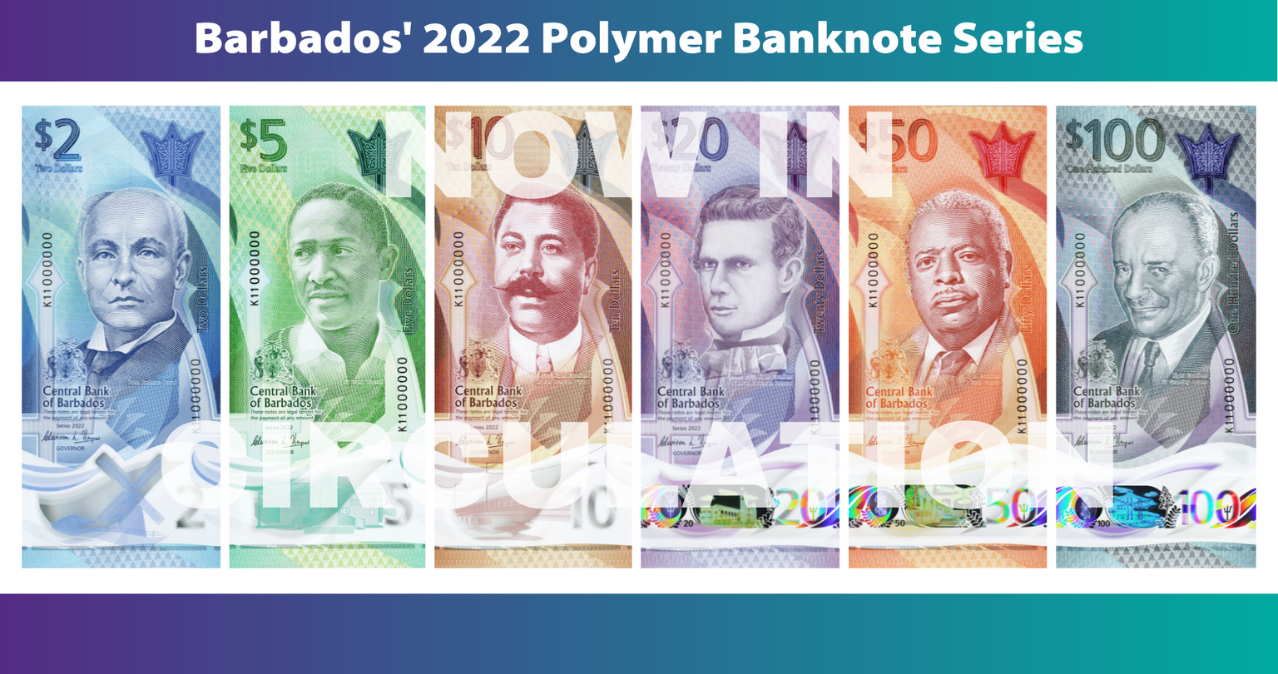
The first Barbadian banknotes, with sophisticated designs celebrating local history and nature, reflect this desire for cultural expression. The chosen symbols—flying fish, bougainvillea flowers and historical figures—project the image of a nation proud of its heritage yet firmly looking to the future.
This period also sees the modernisation of Barbados's financial architecture. The Barbados Development Bank, created in 1969, and various specialist institutions develop the local expertise required for independent monetary management and financing economic development.
The Dollar Peg and Stabilisation (1975-1990)
The 1975 Crisis and Strategic Devaluation
The global economic crisis of 1975, combined with the oil shocks, severely tests Barbados's young currency. Imported inflation and growing trade imbalances call the ambitious parity with the US dollar into question, forcing a strategic reassessment of monetary policy.
The controlled devaluation of June 1975, establishing the rate of 2 BBD = 1 USD, marks a decisive turning point in Barbados's monetary history. Although politically difficult, this decision reveals the authorities' pragmatism and their ability to adapt to international economic realities.
This devaluation is accompanied by ambitious structural reforms aimed at strengthening economic competitiveness. Diversification into high-end tourism, the development of financial services and agricultural modernisation gradually transform the Barbadian economy.
Courtney Blackman, central bank governor (1972-1987), orchestrates this transition with remarkable technical expertise. His prudent management and transparent communication maintain public and international confidence despite the necessary adjustments.
Institutional Consolidation and the Tourism Boom
The period 1975-1990 sees Barbados's monetary institutions consolidate and its modern tourism economy emerge. Supported by restored monetary stability, this transformation positions Barbados as a preferred destination for affluent North American and European tourists.
Massive investment in tourism infrastructure—a modern international airport, luxury hotels and sophisticated marinas—requires precise monetary management of substantial foreign capital flows. The expertise developed in this process lastingly influences Barbados's approach to monetary policy.
This period also sees the emergence of the first offshore financial services. Benefiting from its exceptional political and monetary stability, Barbados gradually attracts international businesses seeking a secure Caribbean base for regional operations.
High-quality education, inherited from Barrow's reforms, produces a skilled workforce capable of managing these sophisticated sectors. This alignment between training and economic needs facilitates the transition towards an advanced service economy.
The Financial Services Era (1990-2010)
Transformation into an International Financial Centre
The 1990s mark Barbados's emergence as a sophisticated international financial centre. Orchestrated under the successive governments of Erskine Sandiford (1987-1994) and Owen Arthur (1994-2008), this transformation skilfully draws on Barbadian strengths: political stability, a British legal system and an educated workforce.
The development of offshore banking attracts global financial institutions seeking an operational base in the Caribbean. This growth is accompanied by sophisticated regulatory innovations that balance attracting capital with compliance with international standards.
Marion Williams, the Caribbean's first female central bank governor (1995-2009), modernises the institution and develops recognised expertise in financial supervision. Her innovations—stronger banking supervision, payment modernisation and risk management—inspire other regional central banks.
This period also sees the development of captive insurance, a sector in which Barbados becomes a world leader. This technical specialisation attracts multinational companies and generates significant revenue while diversifying the economic base.
Diplomatic Excellence and Its Economic Impact
At the same time, Barbados develops exceptional international diplomacy that strengthens its economic appeal. The election of Dame Billie Miller as President of the UN General Assembly (2003), along with various prestigious diplomatic missions, positions the island as a respected participant on the international stage.
This diplomatic excellence has economic benefits, attracting international organisations and regional headquarters of multinational companies. Its reputation for stability and competence also attracts foreign direct investment in sophisticated sectors.
Double taxation treaties negotiated with more than 30 countries facilitate international financial flows and strengthen the appeal of the Barbadian jurisdiction. This legal and tax expertise becomes a major comparative advantage in global competition between financial centres.
Owen Arthur, an economist by training and Prime Minister for 14 years, develops a strategic vision of a knowledge economy that influences monetary policy choices. Prioritising education and innovation, this approach prepares the Barbadian economy for the challenges of the 21st century.
| Sector | 1990 | 2005 | GDP Contribution in 2005 |
|---|---|---|---|
| Financial services | 8% | 25% | USD 680M |
| Tourism | 15% | 35% | USD 952M |
| Agriculture | 8% | 3% | USD 82M |
| Manufacturing | 12% | 8% | USD 218M |
Contemporary Challenges and Transformations (2008-2024)
The Global Financial Crisis and Barbadian Resilience
The financial crisis of 2008-2009 severely tests the resilience of the Barbadian economy, heavily dependent on financial services and international tourism. However, successful economic diversification and strong institutions limit the impact compared with other Caribbean economies.
DeLisle Worrell, central bank governor (2009-2017), navigates this crisis skilfully, maintaining the currency peg while supporting the domestic economy. His prudent management preserves international confidence and avoids a destabilising devaluation.
Nevertheless, this period sees growing structural imbalances emerge: a chronic budget deficit, excessive public debt and the gradual erosion of foreign exchange reserves. These challenges reveal the limits of Barbados's economic model and require structural adjustments.
Freundel Stuart's government (2010-2018) struggles to implement the necessary reforms, generating growing tensions with international financial institutions. This precarious situation allows imbalances to accumulate and lays the groundwork for subsequent crises.
The 2018 Crisis and the BERT Programme
The economic crisis of 2018, characterised by the almost total depletion of foreign exchange reserves and a threat to the currency peg, triggers the largest stabilisation programme in Barbadian history. Mia Mottley, the new Prime Minister, launches Barbados Economic Recovery and Transformation (BERT) with IMF support.
This drastic programme—debt restructuring, tax reform and administrative modernisation—aims to preserve the sacrosanct currency peg while restoring fiscal sustainability. This approach reveals Barbadians' deep attachment to their stable currency.
Cleviston Haynes, the new governor (2017-present), orchestrates this stabilisation with remarkable technical expertise. His transparent management and effective communication maintain public confidence despite the necessary adjustments.
BERT's partial success—restored reserves, improved public finances and preservation of the peg—validates the Barbadian approach of prioritising monetary stability over exchange rate adjustments. This success strengthens the international credibility of Barbados's economic management.
The Transition to a Republic and the Future (2021-2024)
The Republic and Monetary Continuity
The transition to a republic on 30 November 2021, removing Queen Elizabeth II as head of state, takes place with complete monetary continuity. This major constitutional transformation preserves the existing monetary system in its entirety, demonstrating Barbados's institutional maturity.
Dame Sandra Mason, the Republic's first president, embodies this successful combination of political modernisation and economic stability. This smooth transition strengthens international confidence in Barbadian institutions and their ability to adapt.
Monetary imagery gradually adapts to this new republican identity while preserving distinctive cultural symbols. This symbolic evolution accompanies political maturation without challenging established economic foundations.
This political transformation is accompanied by renewed ambitions in environmental sustainability and climate justice. Barbados develops recognised expertise in green finance that diversifies its strengths in international competition between financial centres.
Innovation and Adaptation to Future Challenges
Barbados actively explores digital monetary innovation by developing central bank digital currency (CBDC) projects. Conducted in cooperation with international institutions, this research aims to maintain Barbados's technological lead in financial services.
The development of green finance positions Barbados as a Caribbean hub for climate financing. Supported by diplomatic expertise in climate issues, this specialisation attracts new international capital flows focused on sustainability.
The emerging digital economy—IT services, e-commerce and international remote working—diversifies sources of foreign currency and reduces traditional dependence on in-person tourism. This adaptation proves crucial following the disruptions of the COVID-19 pandemic.
The "Barbados 2030" strategy aims to transform the island into the Caribbean's first "smart nation", combining environmental sustainability, technological innovation and excellence in services. This ambitious vision rests on monetary stability as the foundation of future development.
Conclusion: A Model of Island Excellence
The history of the Barbados dollar, from its birth in 1973 to contemporary challenges, vividly illustrates how a small island nation can create and maintain a stable currency while developing a sophisticated economy. This exceptional path demonstrates Barbados's institutional excellence and its capacity to adapt continually to global transformations.
The BBD's enduring success rests on distinctive qualities: remarkable technical expertise, successful economic diversification, diplomatic excellence and public attachment to monetary stability. Patiently cultivated since independence, these strengths continue to support the currency despite the recurring challenges facing small open economies.
Preserving the US dollar peg for nearly fifty years, despite crises and temptations to devalue, reveals an exceptional national consensus on the importance of monetary stability. Rare in the Caribbean, this consistency may be the Barbadian economy's most valuable asset.
Today, the Republic of Barbados faces the challenges of the 21st century with the confidence gained from more than half a century of successful monetary experience. Its continuing capacity for innovation, growing diplomatic influence and reputation for institutional excellence place it in a strong position to maintain its status as a Caribbean model, confirming that size is no obstacle to monetary excellence when supported by high-quality institutions and a clear strategic vision.
This article draws on the editorial collection supplied in 2025. Figures and descriptions should be read in their original context. About the content